


Schöck solutions: champions of thermal insulation for sports complexes
 InfoWeb Marketplace · Editorial team
Published on 1 December 2017 · 9 min read
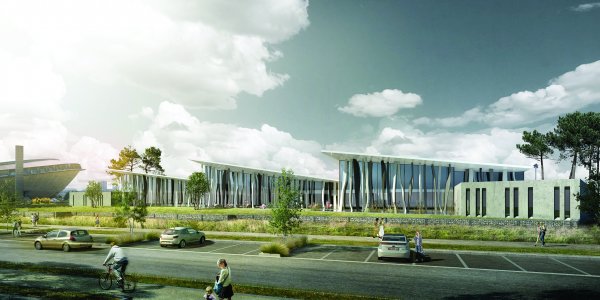
Schöck Isokorb type KST and Schöck Thermoanker solutions: champions of thermal insulation for sports complexes
Schöck, a major player in thermal bridge treatment, whose flagship solution is Rutherma, covered by a CSTB Technical Assessment for internal insulation, and the only manufacturer to hold a Technical Assessment for external insulation and for insulation of roofs, with a range validated whatever the seismic requirements, works on a wide variety of projects: restoration of architectural heritage, thermal bridge treatment in multi-family housing, cultural and leisure facilities...
Today, Schöck wishes to highlight its expertise in the sports complex sector, with references including 3 aquatic centres, in Saint-Hilaire-de-Riez (85), Saint-Fulgent (85) and Saint-Nazaire (44), and 1 performance centre dedicated to rugby, Apivia Parc, in La Rochelle (17).
At the heart of these constructions are the Schöck Isokorb type KST thermal breaks, designed specifically for steel-to-steel connections, on the one hand, and the Schöck Thermoanker thermal connector, made of glass fibre with low thermal conductivity, for precast double walls with integrated insulation, on the other.
Insulation in steel constructions: diving into the heart of 3 aquatic centres with Schöck Isokorb KST
Specifically suited to metal constructions, Schöck Isokorb type KST thermal breaks treat thermal bridges by interrupting the heat flow in the metal structure: structural elements, such as the beams of a frame for example, are separated, and the thermal break is installed in the gap between them.
A high-performance and economical solution that prevents energy and heat loss, Schöck Isokorb type KST also has the advantage of limiting the risks related to humidity and mould: an undeniable asset for aquatic complexes, which are by definition wet areas.
Its ease of installation and its ultimate invisibility have thus convinced 3 project owners of swimming centres, where Schöck Isokorb type KST thermal breaks ensure the continuity of thermal insulation and the transfer of structural loads in the steel frames, while respecting the architectural concept.
Saint-Hilaire-de-Riez (85)
Inaugurated in September, the Saint-Hilaire-de-Riez aquatic centre stands on a covered area of 3.200 m2.
The 850 m2 of pools are divided between a sports pool, a learning pool, an activity pool (aquagym, aquabike, baby swimming, pregnant women, fear of water...), an outdoor pool heated to 28 °C all year round and a paddling pool.
A pentagliss slide and a wellness area (sauna, jacuzzi, hammam) complete the facilities of this sumptuous complex. A particular feature: water treatment with ozone, a natural process recognised for reducing the drawbacks of chlorine (skin reactions, allergies...) and reputed to cause less corrosion on the structure.
The project by the Bordeaux-based firm Brochet Lajus Pueyo won over the jury with its bold architecture featuring a metal lattice, as well as its optimal integration into the landscape. ?Seen from afar, only the hall rises above the landscape of copses and fields with geometric patterns.
The roof is expressed in three petals, suspended above the ground; the reasoned form of the structure evokes the movement of water, the undulations of a manta ray. The abstract character of this roof levitating above the landscape is made possible by a peripheral lattice structure, which surrounds the pool area and supports the roof as an integrated structural whole.?
The undulating frame, made of galvanised then lacquered steel, consists of elements manufactured at various industrial sites depending on the dedicated tooling (the curved elements, for example, were produced in Portugal).
But only Schöck was entrusted with the task of treating the thermal bridges in an external insulation configuration. About a hundred connections were thus treated with Schöck thermal breaks: mainly the Isokorb type KST and KST-QST models for the horizontal junction between steel beams, but also Rutherma thermal breaks for concrete-to-concrete connections in certain areas of the building (such as the hammam area, for example).
Schöck Isokorb type KST thermal breaks were indeed the most efficient solution for treating thermal bridges compared with so-called on-site solutions, such as neoprene pads or other spacer plates.
Treating the thermal bridge of cantilevered canopies requires handling shear forces, tensile forces and compressive forces at once, hence the need to combine two types of thermal breaks: the KST-QST model, which handles compressive and shear forces, and the KST-ZST model, which handles tensile forces.
What they have in common: stainless steel elements passing through an expanded polystyrene insulating body and installation by a simple bolted connection.
Words from the thermal engineering firm Ethis, specialised in aquatic complexes...
Pierre-Marie Derrian, Thermal/Fluids Account Manager at Ethis in Lorient, explains his choice to recommend Schöck thermal breaks: ?Although specifying them is not required by thermal regulations - RT2012 not applying to swimming pools -, treating thermal bridges at interior/exterior metal junctions in humid areas on the heated side (pool areas) stems from the wish to avoid dew point zones and, consequently, in the long term, mould or corrosion.?
The thermal break solution, positioned in the plane of the insulated walls and glazed walls, also has a favourable aesthetic impact compared with an insulating envelope around the exterior canopies, which would thicken the overall appearance. The ?invisible? nature of the thermal breaks once installed therefore supports the architect's wish for a light and elegant whole offering views at 180 ° to the south, east and west.
Once the thermal requirements had been passed on to the structural engineering firm Kephren in Bordeaux, it pre-sized the thermal breaks selected for this project with the help of the Schöck engineering department.
This is a strong added value of Schöck's expertise: each thermal break is manufactured specifically for a defined project, made to measure!
Saint-Fulgent (85)
Also opening its doors in September, the Aqua°Bulles aquatic centre in Saint-Fulgent (85), designed by Arcos Architecture together with Cabinet AADP, again combines originality and modernity: located on a high point with its entire south/south-west side glazed, it offers natural light and a privileged view of the surrounding landscape of hedged farmland and crops.
Of note is an innovative environmental aspect: its 3 stainless steel pools (sports, leisure and activities), which discourage bacteria and improve hygiene (no joints), lead to a reduction in treatment products and maintenance time as well as, at the same time, greater ease in heating the water, which does not need to be drained twice a year as is the case with traditional pools.
Moreover, 80 % of domestic hot water and heating needs will be covered by a wood-fired boiler room supplied by a local supply chain. Almost all of the filter washing water is treated and reused for the next operation.
While the project proves as unusual as Saint-Hilaire-de-Riez, the structure this time rests on a skilful arrangement of columns around the perimeter of the building, orchestrated by the engineering firm ATES. The covered space is completely open, with no pillar hindering circulation throughout, and a maximum roof span of 45 m.
?It was essential to respect the slenderness of this organic roof delicately resting on light supports. And this without compromising on thermal performance. The Schöck thermal breaks were able to adapt to the technical complexity of the structure,? explains Christophe Barbe, Technical Director at Atelier Arcos Architecture.
?The glazed wall separates the inside from the outside but, at the level of the steel frame, the beams create a continuity between outside and inside, meaning, to put it simply, that the cold comes in while the heat goes out via this connection.
The Schöck thermal breaks therefore ensure thermal continuity and structural transfer of forces between the two beams,? explains David Beleteau of the company DL Atlantique, which specialises in steel frames.
Saint-Nazaire (44)
Transparency and brightness characterise the architecture proposed by the Coste agency. Thanks to its raised volume and large glazed bays along the pool hall, the Saint-Nazaire aquatic centre, bathed in natural light, offers a superb view of the landscaped park, while sharing its forecourt with one of the city's emblematic buildings, La Soucoupe, a boxing hall designed in the 50 and listed as modern heritage.
While the structural columns inspired by kelp bring lightness to the 5.435 m2 building, its 3 roofs harmonise with the unity of La Soucoupe.
The aquatic centre comprises 4 pools (swimming; warm-up and activities; learning; relaxation and play), a pentagliss slide, a paddling pool and a health/relaxation area with hammam and sauna.
As with the aquatic centres in the Vendée, the choice to use Schöck thermal break solutions is first and foremost part of a quality-driven approach: the aim is to eliminate the risk of mould and condensation in the swimming pool and thus to limit the risk of structural deterioration.
Thomas Pertriaux, site manager at the Coste agency, explains: ?Once the architectural choice falls on a steel frame rather than glued laminated timber, two options are available in terms of thermal treatment: on one side, flocking (spraying of mineral wool containing a binder) and on the other, thermal breaks.
While flocking often gives a rougher result aesthetically and a less durable one qualitatively (sensitivity to impacts, crumbling...), the thermal break acts like a chameleon, invisible from the outside since it is installed on the inside, with optimal durability over time.?
A new try scored for the Schöck Thermoanker connector: the Stade Rochelais Performance Centre, Apivia Parc (17)
The Schöck Thermoanker composite reinforcement, made of glass fibre-reinforced plastic, offers exceptional advantages over steel for reinforcing concrete: resistant to alkaline environments and corrosion, this connector is easy to cut and has a very low thermal conductivity.
Thanks to this Schöck innovation, precasters have an alternative to conventional anchors for producing double walls that is economical (only 4 connectors needed per m2) and virtually free of thermal bridges.
With easier installation: Schöck Thermoanker is placed effortlessly in the recesses provided for this purpose in the insulation boards, avoiding the need to fill voids with foam as is the case with traditional anchors.
The Schöck Thermoanker solution was thus chosen by Groupe GA to build the precast façade walls of the Stade Rochelais Performance Centre, Apivia Parc (17).
Apivia Parc consists of an L-shaped building of 4.000 m2 on two levels, with an entrance hall, changing rooms and toilets for the pro squad in one wing, and for the academy squad (U22) in the other wing, as well as two weight rooms divided according to the same categories.
The upper floor houses the administrative offices, a restaurant, a video room and a cardio-stretching area. A covered training pitch with synthetic turf completes the facilities.
?We designed the Stade Rochelais Performance Centre project based on universal values, emblematic of the world of rugby while also common to the world of builders: rigour, strength, respect, humility and conviviality (...).
We wanted an architecture conveying an image of stability and robustness through the use of raw concrete, sometimes textured with a vertical wood pattern, sometimes smooth in a light shade for most of the elevations,? says Jean-Pierre Renaud of Agence Architectes Associés.
He continues: ?Concrete, widely used in double-skin and insulated panels, offers durability over time and resistance to impacts and wear, along with unmatched thermal inertia and comfort.
It is also widely used inside the building where, here and there, the use of paint creates atmospheres and brightness.?
Groupe GA was entrusted with the construction of this ambitious project, with the façade panels prefabricated at the Criquebeuf-sur-Seine plant (27). In total, 6.700 Schöck Thermoanker thermal connectors were used in the 180 sandwich panels making up the 2.000 m2 of façade.
The challenge was a very short completion time, since the overall project, started in December 2016, was completed in only 8 months: the prefabrication of the walls was thus optimised over two months (February and March 2017), then the delivery of the panels to the site was organised over 15 days, at a rate of about ten panels delivered per day (2 panels per truck with special trailers).
Unrivalled expertise... Schöck France, a subsidiary based in Entzheim (near Strasbourg), develops and markets a range of ultra-high-performance thermal bridge solutions.
The Schöck range meets the various challenges of construction by offering tailor-made solutions for concrete-to-concrete, concrete-to-steel, steel-to-steel and even concrete-to-timber connections.
Schöck reports annual turnover of 158,8 million euros in 2016 and a commercial presence in 31 countries.